
Start with furniture you can identify, inspect, move, and resell without guessing. Search for specific styles, brands, or item types. Before messaging, add up transport, cleaning, repairs, missing hardware, and your time. A low asking price does not always leave room for profit.
The hunt is the fun part. The margin usually disappears in the boring details: a swollen drawer, a missing rail, a two-hour pickup, or a sofa nobody wants to carry down three flights of stairs.
Choose what kind of furniture to flip
“Furniture” is too broad. Choose a small group of pieces you can judge quickly.
A useful category has three traits:
- You can recognize the item. You know the common sizes, materials, brands, and failure points.
- You can inspect and move it. The piece fits your vehicle or a delivery cost still leaves room in the deal.
- You know who buys it next. A student desk, solid timber dresser, and premium office chair attract different buyers.
You do not need to know every category. Avoid pieces you cannot inspect or price with confidence.
Use searches that sellers actually write
Marketplace sellers rarely describe furniture consistently. One person lists a “mid-century teak dresser.” Another writes “old timber drawers.” A third uses the brand and nothing else.
Build a short list of searches for the same item:
| What to look for | Searches to try | Details to confirm before pickup |
|---|---|---|
| Premium office chairs | Herman Miller Aeron, Aeron size B, Steelcase Leap |
model, size, cylinder, tilt, arm adjustments |
| Solid timber storage | teak dresser, timber drawers, MCM dresser |
veneer vs solid timber, drawer movement, water damage |
| Small tables | oak side table, vintage coffee table, nesting tables |
wobble, veneer chips, dimensions, repair history |
| Modular shelving | brand or system name plus shelf |
missing brackets, wall fixings, matching components |
Run the exact search first, then try one or two variations. Our better Facebook Marketplace search guide shows how to test and improve each search.
Price the work, not just the furniture
Before you call something a deal, write down every cost between the seller’s door and the next buyer:
- purchase price
- fuel, tolls, delivery, or vehicle hire
- cleaning supplies and replacement hardware
- repair materials
- selling fees, if you cross-list elsewhere
- time spent collecting, repairing, photographing, and messaging
- the chance the piece sits unsold and takes up space
Use conservative numbers. If the deal works only when everything goes perfectly, it does not work yet.
A simple pre-message test
Ask yourself:
- What fact would make me walk away?
- Can the seller prove that fact with one photo or measurement?
- Can I move the piece without improvising at pickup?
- Is there still enough room after the obvious work?
If you cannot answer those questions, do not race across town because the listing says “must go today.”
Ask questions that prevent wasted trips
Before messaging the seller, save every photo from the listing. Upload them to ChatGPT, paste the full listing description, and add anything else you know about the item.
Then use this prompt:
Turn the listing into useful seller questions
I am considering buying this used furniture item.

Review the listing description, all attached photos, and the extra context below. Help me work out what I need to ask the seller before I spend time travelling to inspect it.

Listing description:
[PASTE THE FULL LISTING DESCRIPTION]

Extra context:
- Asking price: [PRICE]
- What I plan to do with it: [KEEP IT / REPAIR IT / RESELL IT]
- Transport limits: [VEHICLE SIZE, STAIRS, DISTANCE OR OTHER LIMITS]
- Anything else the seller has told me: [PASTE HERE]

Please:

1. Summarize what the item appears to be, including its likely material, construction, brand, model, and condition. Clearly label anything you are unsure about.
2. Point out possible damage, missing parts, repairs, wear, or warning signs visible in the photos.
3. Tell me which important areas are not shown clearly.
4. Give me 5–8 questions to ask the seller before arranging pickup. Prioritize questions that could reveal a deal-breaker.
5. Ask for specific extra photos or measurements where they would help.
6. Do not repeat anything the listing has already answered.
7. Finish with a short message I can copy and send to the seller.
8. List anything that can only be checked properly in person.

Do not assume the item is safe, genuine, solid timber, structurally sound, or in good condition just because it looks that way in a photo.
See how it works on a listing
A cheap coffee table with unanswered questions
This sample listing gives us one photo and a vague description. That is enough to ask better questions, but not enough to judge the table.
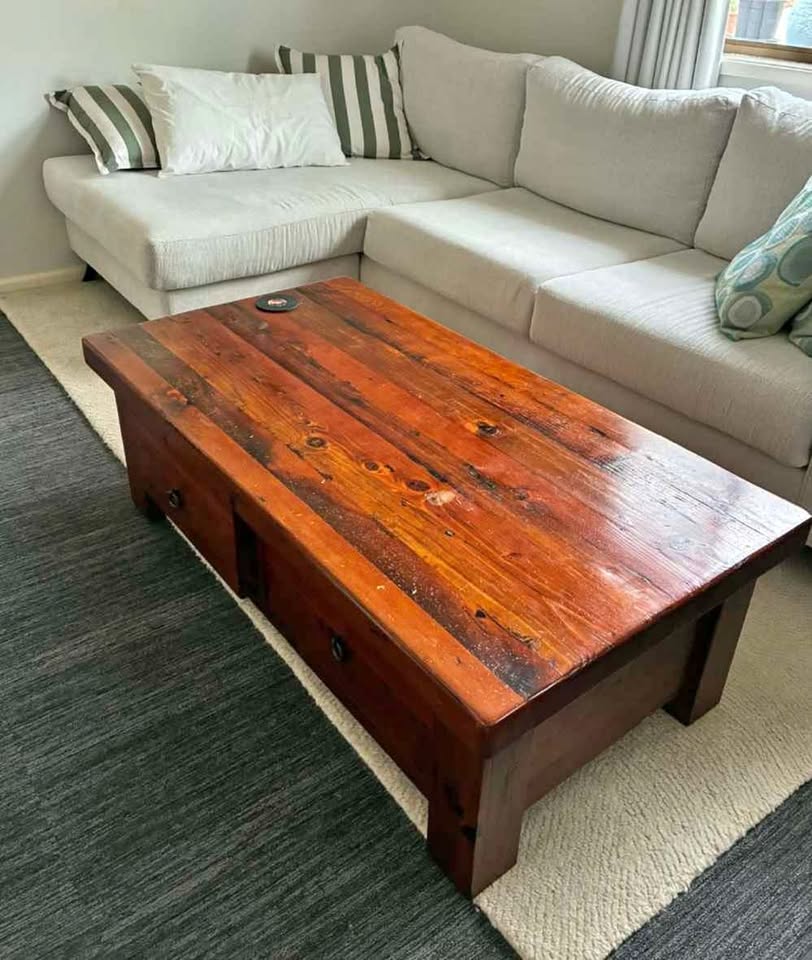
- Marks on the top: are they light finish wear, deep scratches, heat marks, or water damage?
- Drawers shown closed: ask whether both open smoothly and request a photo of the interiors.
- One viewing angle: request the back and underside so you can see joints, repairs, swelling, and missing hardware.
Questions worth asking
- Are the top marks only in the finish, or can you feel grooves or swelling?
- Do both drawers open and close without sticking?
- Has any leg, joint, or drawer runner been repaired?
- Could you send photos of the back, underside, and drawer interiors?
- What are the exact width, depth, and height?
A message the seller can answer
Hi, could you tell me whether the marks on top are only in the finish and whether both drawers open smoothly? Could you also send photos of the underside, back, and drawer interiors, plus the dimensions? Thanks.
Still check at pickup
Test for wobble, loose joints, odors, pests, dampness, and sticking drawers. Confirm the table fits your vehicle before paying.
Read the questions before sending them. Remove anything unnecessary and keep the message short. ChatGPT can help you spot what is missing from a listing, but it cannot smell smoke, test a chair cylinder, find hidden pests, or confirm that a joint is solid. Inspect the item yourself before paying.
Photograph the condition before you improve it
Take clear “before” photos as soon as you collect the piece. They help you remember what was repaired and make honest resale descriptions easier.
Then photograph the finished item in daylight with:
- one full front view
- side and rear views
- drawers or doors open
- brand labels and construction details
- honest close-ups of remaining wear
- one room photo that shows the size
Good photos do not hide flaws. They stop the next buyer from discovering them in your driveway.
Use alerts only after the search is useful
A broad “furniture” alert will train you to ignore notifications. A narrow “Aeron size B” or “teak dresser” search gives you something you can inspect quickly.
Check the results yourself first. When most of the first page is relevant, save the search. Spottable Marketplace alerts can keep paid searches running in the background. The free tier gives you 3 AI analyses a day to check whether the price looks fair, spot red flags, and draft seller questions.
Spottable does not know whether a dresser smells like smoke or whether a chair cylinder sinks under your weight. It helps you decide what deserves an inspection. You still make the final call in person.
Keep the meetup boring
Furniture pickups often happen at a seller’s home because that is where the item is. Share the address and timing with someone, bring help for heavy pieces, inspect before paying, and leave if the situation or item does not match what was agreed.
For smaller pieces, a public meeting point may be practical. For more safety checks, read how to spot Facebook Marketplace scams.
Use the same checklist for every piece
- Pick one furniture lane you can judge.
- Create three or four short search variations.
- Reject pieces where transport and repairs cost too much.
- Ask for the missing proof.
- Inspect before paying.
- Record the real costs and time after the sale.
- Improve the next search using what you learned.
The advantage is not finding every cheap piece first. It is recognizing which cheap pieces are worth the work.
Sources and further reading
- Facebook Marketplace for Facebook’s current features
- Facebook Marketplace Help for Facebook’s current help articles and policies
- Best Facebook Marketplace apps
- How Spottable’s AI analyzes deals
Frequently asked questions
What furniture is easiest to flip on Facebook Marketplace?
Start with pieces you can identify, inspect, transport, and improve without specialist tools. Solid timber dressers, recognizable office chairs, small tables, and simple storage pieces are often easier to assess than upholstered furniture or badly damaged flat-pack pieces. Local demand still matters.
How do I find underpriced furniture on Marketplace?
Run several short searches for the same item, including common abbreviations and words sellers use. Check new listings regularly, but include transport, cleaning, repairs, hardware, and your time before treating a low asking price as profit.
Should furniture flippers use Marketplace alerts?
Alerts help after a search reliably returns furniture you would inspect. Test the search manually first. A broad alert such as furniture can create constant noise, while a focused search such as teak dresser or Aeron size B is easier to act on.
How does Spottable help furniture flippers?
Spottable cuts junk from Marketplace results, checks whether a listing looks fairly priced or suspicious, and drafts seller questions. It starts free with 3 AI analyses per day. Paid plans add saved searches and notifications.